Showing posts with label Moneyball. Show all posts

Tuesday, December 11, 2012

MoneyBall vs CashBall


I would have plenty to comment on the Yankees postseason moves...if there were any. Usually there are transactions and plenty of distractions, but this year there's mostly inaction.

Don't get me wrong I think the brain trust knows what it's doing, but this is just boring. They re-signed Hiroki Kuroda and Andy Pettitte to 1-year deals. And just now as I write, Kevin Youkilis has signed a 1-year deal to hold down third base for a bit. And all signs point to Ichiro re-signing for one year as well. There is Moneyball, and there is Brian Cashman-brand CashBall.

This is not a calm before the storm, but rather a method to the madness - as I mix metaphors. The Yankees' over-inflated payroll has cost the team a fortune in salary cap luxury tax. Now after seeing the exponentially diminished ROI on the A-Rod investment, they are being a lot more frugal to keep their payroll in line. As opposed to teams like the Dodgers.

The 1-year deals make sense, not just for the veteran pitchers, but for Youkilis as well. Alex Rodriguez still has multiple years left on his contract and will be set back by hip surgery to start the year. It would be difficult to see him playing anything other than DH when he returns. And if he can't hit, that would make for a very ineffective DH. Youkilis is a proven hitter (though not last year) and a strong defensive 3B.

There is still a fairly large hole at the catcher position, after Russell Martin signed a free agent deal with Pittsburgh. I don't have a problem with this as I see catcher as a defensive position first, and it's not like Martin set the world on fire with his bat (.211, 21 HR in 2012). For historical reference, the Yankees replaced Mike Stanley with Joe Girardi in the mid-90s, which coincided with a dynasty. Hmm.

But the Yankees now are down to three catchers on the 40-man roster: Chris Stewart, Francisco Cervelli, and Austin Romine. We don't expect much at the plate, but which of these perennial backups and career minor leaguers will handle a venerable pitching staff?

What you do see is an emphasis on speed: Brett Gardner, Chris Dickerson, Eduardo Nunez, and Ichiro Suzuki (if he's back) are all guys that can steal 30+. So what we see here is not only a re-shaping of the Yankees organizationally, but on the field as well.

The upcoming season promises to be interesting, even if the offseason hasn't been.

Thursday, October 25, 2012

Working Hard For The Money


Game 1 of the 2012 World Series will be remembered for many things, like Pablo Sandoval's three Home Runs (two off Justin Verlander), and who it puts him alongside in the history books.

But there was another significant hit off Verlander, when Barry Zito slapped an RBI single to left in the bottom of the 4th. Zito was 4-53 (.075) at the plate in the regular season, but had been maligned since his arrival with the Giants, for other reasons.

It's because Zito signed a 7-year, $126M contract with the Giants on December 29, 2006. And since switching sides of the bay he had been a colossal bust.

But there had been a time when Zito seemed like a can't-miss investment. When Oakland had Zito, Mark Mulder, and Tim Hudson way back at the turn of the century, they were that decade's answer to Maddux, Smoltz, and Glavine. They were backbone of the A's success, while Moneyball supplemented them.

In 2002 the A's won 103 games, it was the pinnacle of those teams. Barry Zito won 23 of them and dazzled his way to a Cy Young award. But they lost in the ALDS for a third straight year, this time to the Twins instead of the Yankees. It got Art Howe fired.

The Twins lost to the Angels in the ALCS, who eventually won the World Series by rally-monkeying past... the San Francisco Giants. Life is a circle sometimes.

While Zito will likely never justify the $126 Million that was spent on him, he never quit trying to earn it. Zito went 43-61 in his first 5 years with the Giants and was left off the 2010 playoff roster. But he was a more than respectable 15-8 this season, and has already notched two huge postseason wins. And Giants fans know it.


There was an article in Thursday's USA Today, paralleling the Zito contract with the recent money bombs thrown AJ Burnett and Daisuke Matsuzaka.

The Yankees committed $82.5M to AJ Burnett, who went 34-35 in three seasons in New York before being exiled to Pittsburgh for the final two years of his deal (Burnett was 16-10 this year). But when the Yankees lost Game 1 of the 2009 World Series, Burnett was brilliant in Game 2 to springboard his team to a championship.

Red Sox fans throw their hands up in the air every time Matsuzaka pitches now, but does that nullify him winning Game 7 of the 2007 ALCS or Game 3 of the World Series? Or an 18-3 season the next year?

There are sometimes unexpected dividends on dubious investments. You get the feeling Barry Zito's portfolio isn't quite closed.

Tuesday, October 16, 2012

Paper Backtime: MoneyWall


It's always a pleasure to read one of the more eclectic voices of our generation. His sports-themed books Moneyball and The Blind Side were developed into highly-acclaimed motion pictures. And in the last year, Lweis has taken to a number of different projects:

His 2012 commencement address at Princeton, his alma mater, was widely received for delivering a message that was well outside the box. The same can be said of his Vanity Fair profile of President Obama.

Or my favorite, the one-page Foreword in Mike Leach's autobiography Swing Your Sword, titled "The Importance of Peeing on the Dog."

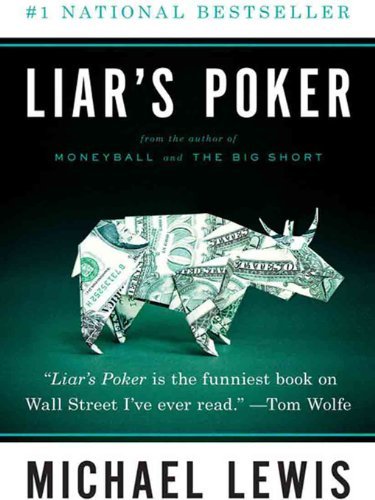
But Lewis's bread and butter is his unique documentation of the financial world. He wrote The Big Short about the real-estate meltdown and Boomerang about the global economic crisis. But it all started with the 1989 semi-autobiographical Liar's Poker, chronicling the 1980's Wall Street boom, which of course was a house of cards.

I actually worked on a Wall Street trading desk in the summer of 1987, scribbling stock and option orders at a clearing house for small brokerages. I didn't take much away from the experience other than the blue "sell" and pink "buy" memo pads I swiped on my last day.

I went to Syracuse for my freshman year in late August, and the market crashed two months later. Black Monday was October 19, 1987 when in one day the market dipped 23%. I would've loved to be a fly on the wall on the trading desk that day. Lewis's book chronicles the events, but even more so the attitudes that led to it.

Lewis wasn't on Wall Street in physical address only. He reconstructs his entry at Salomon Brothers and quick ascension through the London bond trading desk to his confirmation as Big Swinging Dick (his words, not mine).

Stock (equity) trading was a banishment at Salomon. Bonds were where it was at, especially mortgage bonds. Lewis paints a bunch of fat piranhas playing huge gamblers, using money to make money in the most Machiavellian manner, and moving tens and even hundreds of millions of dollars within seconds.

"There was a phenomenon known at Salomon as a priority. A priority was a huge number of bonds or stocks that had to be sold, either because selling them would make us rich or because not selling them would make us poor. When Texaco teetered on the brink of bankruptcy, for example, Salomon Brothers owned about one hundred million dollars' worth of bonds in the company. There was a real danger that these bonds would become worthless. Unless sold to customers, they could cost Salomon a great deal of money. Sold to customers, of course, they would cost the customers a great deal of money. That, it was decided, was the best thing to do. Texaco bonds therefore became a priority for the Salomon sales force." (p. 224)

After making $225K as a 27-year old, and that money went a little further in 1988 mind you, Lewis decided to hang up his suspenders and phone bank.

"My father's generation grew up with certain beliefs. One of those beliefs is that the amount of money one earns is a rough guide to one's contribution to the welfare and prosperity of our society." (p.307)

Lewis left Salomon Brothers to contribute to society rather than merely profit off of it. He would modestly have you believe (refer to the Princeton speech) that he achieved what he has in life by luck, a series of fortunate events.

I think there's some truth to that, but it's what you can do with the ball when it's fortunate enough to come your way. Lewis just happened to be sitting next to the wife of a Salomon manager at a royal dinner while at grad school in London. He just happened to leave a lucrative career in investment banking to become an influential writer.

I like to say "things don't happen for a reason; there's a reason things happen." All of our decisions aren't perfect, Lewis after all has been married three times. But more often than not, we make our own luck.

I like Lewis's work a lot. So I picked up Liar's Poker hoping to understand how banks could take on this much risk, and learn about leverage buyouts and the like. I hoped a straight-talking and pretty humorous writer could dumb it all down for me. He was only partially successful. I need to get an MBA. Maybe I can change my own destiny.