Showing posts with label Vietnam. Show all posts

Wednesday, October 24, 2012

Paper Backtime: Maddow On Defense


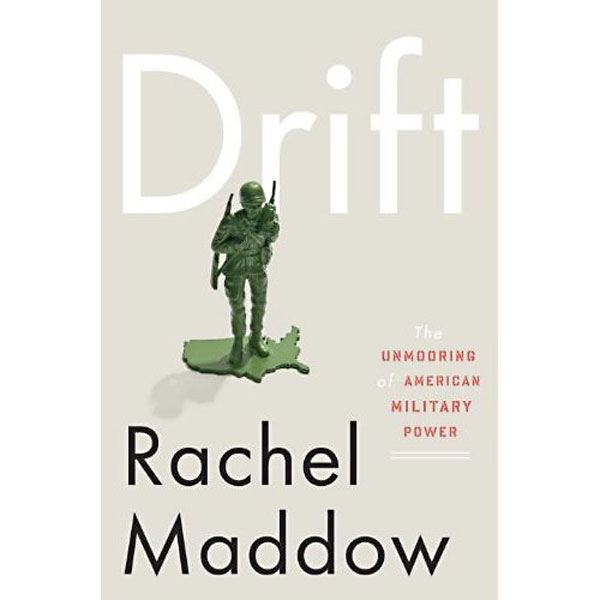
With the third Presidential debate as a backdrop, I thought it would be appropriate to release Backtime's notes on Rachel Maddow's first book, Drift: The Unmooring of American Military Power.

Many of my friends and colleagues unfortunately take their cues from Sean Hannity and Charles Krauthammer, and would dismiss this book solely on the basis of its author. Their loss. 

In fact, here is a prominent testimonial lifted from the back cover:

"Rachel Maddow makes valid arguments that our country has been drifting toward questionable wars, draining our resources, without sufficient input and time. People who like Rachel will love the book. People who don't will get angry, but aggressive debate is good for America. Drift is a book worth reading.

~ Roger Ailes, chairman and CEO, Fox News

War is hell. War is supposed to hurt. When America is at war, everyone is supposed to feel it. That's what the framers like Jefferson and Madison had in mind. The reason to go to war could be too personal or idealogical or partisan for a President to declare, without a congressional ratification process. It's the nature of our checks and balances government system.

But as Ms. Maddow argues, that process has been circumvented in the last 50 years. Now administrations routinely detach our military personnel from the American whole, and place them at their whims like the plastic GI Joe figurine that guards the book's cover.

The first such case was Vietnam, when Lyndon Johnson would gradually increase military presence so as to have a war on the ground out there, without America feeling the effects of war at home. Fighting "a war on the cheap" was obviously ineffectual and deadly for our soldiers, so it was stepped up into a full-scale war.

Ronald Reagan was ultimately the one who tipped the balance in avoiding congressional approval and taking direct military action. First in Grenada, when the US intervened after a communist coup in a country no one had ever heard of, an incursion described by the UN General Assembly as "a flagrant violation of international law."

Then Reagan became obsessed with the crusade of the Nicaraguan Contras, which spawned the clandestine Iran-Contra business, which featured a Watergate-like list of characters facing the music. Reagan didn't have to, despite repeated end runs around congress to trade arms for hostages to fund Central American freedom fighters. Even with the President's fingerprints all over it, the theory is since Reagan was beloved and in ill mental health, an impeachment would've been too heartbreaking for the nation.

The congressman who fought for Reagan's executive authority was Dick Cheney of Wyoming, who coincidentally became George H. W. Bush's Secretary of Defense. When Bush wanted to go liberate Kuwait from the Iraqis, he tried to push executive action. But Congress held him up until January of 1990, when the first Iraq war was approved.

The system worked, in theory. But the major troop outlays now all over the world made us re-think how to handle finances. Along came military contractors. The military need not be responsible for food services, laundry, general transportation, etc., and thus started down the road to privatization of war. And that meant war for profit.

This became problematic during the issues in Bosnia under Clinton, when military contractors were accused of atrocities, including abuse of women and children.

Then came Bush #43, 9/11 and Afghanistan. Which morphed into a search for WMDs in Iraq, to the exhaustion of our forces. But there was no draft as the country at large was spared the sacrifice, we were even given tax cuts; enter Halliburton and Blackwater to pick up the slack over there.

And now under Obama we have increased drone attacks, where we push a button here and a neighborhood on the other side of the world goes boom. No troops in harm's way. No PTSD. No rules of engagement.

Maddow's book isn't too different stylistically from her program. While she is very clever, she is rarely glib. She still entertains in a very roundabout way, but ultimately connects all the dots and opens eyes.

Most importantly she doesn't blame either party, rather chronicling the US history and the tension that exists when politics and military action become intertwined. We are also ultimately a nation that despises war, and legislators are problem solvers (which often creates more problems) so if we can go to war without being at war, it's a win-win, right?

Hence The Unmooring of American Military Power.

Saturday, September 1, 2012

Paper Backtime: Rather's Journey in Journalism


I saw Tom Brokaw in an elevator once. I was carrying a copy of Jeff Shaara's Gods and Generals. He mumbled, "good book." I instantly felt more intelligent.

I informally met Peter Jennings several times while I was at ABC Sports. I would edit college football teases in the basement and he would occasionally go down there to sneak a smoke.

I had always thought of Dan Rather as the stodgiest of the Big 3 of my generation. He was the dry anchor at the old, white guy network. I never thought of him as a progressive crusader, the way the right wing painted him in 2004 when Bush 43 was running for reelection.

The report on George W. Bush's missing time from his National Guard service in 1972 and 1973 created a political firestorm that ultimately led to his ouster from CBS. Rather admits that he learned after the fact that a source was tainted, and the chain of evidence of the notorious Killian documents couldn't be completely accounted for.

But he stands by the story that ran as factually correct. And no evidence has been presented to dispute it. And he goes to great lengths detailing his lawsuit vs CBS (which was thrown out by The Court of Appeals before the first suit was ever tried), and about the political pressure that super-corporation Viacom was under not to allow CBS News to cast the President in a negative light in an election year.

But "George Bush and the Texas Air National Guard" is only Chapter 2; Chapter 1 is titled "Abu Grahib," after CBS News first broke the pictures and report from the infamous Iraq prison. The pushback Rather received from his superiors was his first indicator that the network's brand (he often refers to the CBS eye figuratively tattooed on his ass) was compromised.

It had been the network of Murrow and Cronkite. Now it was a "nit on the nut of a gnat" in Viacom world. CBS News was expected not to upset the corporate business with the FCC or any other branch of government.

After the first two chapters, Rather then tells the story of his life from his humble beginnings in the depression-era and the "poorest white neighborhood in Houston" and the remarkable journey to a network anchor chair.

His time at CBS is really a map of the history of network news as we know (knew?) it. He draws a line from Civil Rights to the Kennedy Assassination to Vietnam to Watergate, and he's right in the middle of it all.

Rather credits the pictures provided by television news to the advancement of Civil Rights. He was on the ground in Oxford, Mississippi and Albany, Georgia and Birmingham, Alabama. And people knew who he was, so he frequently had to switch hotels and hotel rooms from night to night, while Civil Rights leaders kept updating their plan as well.

They needed to get their story out - visually. And perhaps most of all, they needed to find a police chief that was so filled with racial hatred, and was such a dumbass that he didn't care what the pictures looked like.

That was Birmingham's Bull Connor, who ordered that the high-pressure fire hoses be turned on children. The pictures live to this day.

On the Kennedy Assassination, Rather was the Dallas bureau chief. He was covering the President's visit, and wound up being on the air around the clock for days.

He rotated out of his position as London correspondent to spend the better part of a year on the ground in Vietnam, with a crew getting the real action.

And Rather (down the list from other CBS newsmen) made Nixon's Enemies List amid the Watergate hearings. While newspapermen broke the story, America was introduced to the cast of CREEPy characters through TV coverage of live hearings.

Ultimately Rather is in a good place now with HDNet's Dan Rather Reports, and is still going strong at age 80. The book's epilogue is titled "Corporatization, Politicization, and Trivialization of the News."

In 1823 Thomas Jefferson put it succinctly: "The only security of all is in a free press." Alas, when you have a press that has become compliant to politicians, owned by corporations and staffed by people who only want to entertain and obey their corporate masters, the plan fails. The "free press" is no longer a check on power. It has instead become part of the power apparatus itself.

It's (sort of) the mission of HBO's The Newsroom, a show Rather has endorsed, if you take away the cringe-inducing romance and endless monologuing.

My one critique of the book is as he describes 60 Minutes producer Jeff Fager, now CBS News honcho who Rather greatly respects, despite how it ended:

He's not a great writer - often the mark of a really good producer

What the hell does that mean? A "hard news" man like yourself probably wouldn't title his book something so pithy as Rather Outspoken. 

Would You, Rather?